 ]]>
]]>One of the tips given by the city to stranded bus riders is to try cycling.
Charles Akben-Marchand, past president of Citizens for Safe Cycling, said that while winter cycling might not be for everyone, it is certainly a viable option for those left without a ride.
ICY CONDITIONS
He suggests that bus riders who choose to take their bikes instead should keep in mind that the roads are icy and snow covered and that knobby tires are best suited for slippery situations.
Akben-Marchand said to try cycling on the route you are going to take to work on a day off so that you know how long it will take, keeping in mind it will be slow going for cyclists just starting out after retiring their bikes after the summer.
“It’s harder to adjust to starting cycling in the middle of the winter than if you were doing it every day,” said Akben-Marchand.
Now, I live and work downtown, so put my bike away in the winter, but am secretly envious of those that do continue to bike when the weather gets colder. In centretown, at the very least, the roads are kept clean enough that, except when it is actually snowing or freezing rain, conditions don’t seem that much different than in the rest of the year; on the other hand, I fear what the salt will do to my commutting bike (and have a hard time justifying a winter beater.)
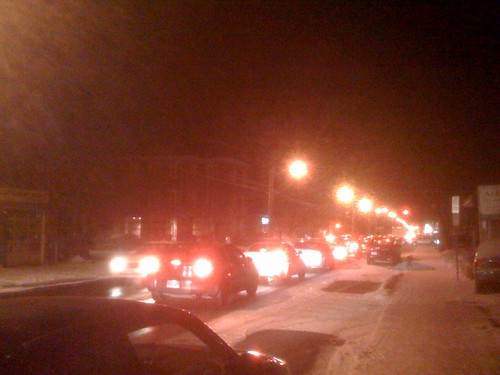
More importantly, with the (temporary) closure of a bridge to Gatineau, traffic downtown was absolutely crazy last week- on Friday, Gladstone (see above) was bumper to bumper -something I haven’t seen in the four years I’ve lived here. Even side streets like Bay and Percy were much busier than usual. With a transit strike, things will only get worse. Conditions might be less than ideal, people will be frustrated, and probably (and sadly) unlikely to expect bicycles. So, do leave lots of time and be safe if you do bring out the bike.


 ]]>
]]>
You can now plan your OC Transpo trips with the slick, user-friendly and efficient Google Transit.


 ]]>
]]> ]]>
]]>I of course, will be voting against anything with a downtown tunnel.


 ]]>
]]> ]]>
]]>To me, this is one of those political decisions that you can’t help but look at and laugh. First, I’m generally very skeptical of the effect a PST tax break will have on the purchase of bicycles. (“Wow… the PST has been taken off. Now I’ll by that bike I’ve been wanting for years!!”) More importantly, though, I think it’s unfortunate when politicians lend their support to an important issue – here, sustainable transportation methods – through completely token measures.
Sustainable transportation is an issue that needs government aid. There has to be investment in public transportation (with a capacity to take bicycles on board). There has to be a commitment to building fewer roads, but more bike paths, light rail tracks and subway lines. These involve serious financial commitments (which, to be fair, McGuinty has been better than most) and aren’t helped at all by token expenditures like this one.
I’m glad to see that the McGuinty government feels that bike transportation is an issue worth supporting (I would hope so, given that I happen to know that his son is a member of the U of O Environmental Law Students’ Association). I just hope that next time he will try to win his political points on real investments, not small ones with questionable effectiveness.


 ]]>
]]> ]]>
]]>
The Toronto Star today talks about the dangers of cycling in Toronto due to a conspicuous lack of bike lanes and the failure of City Council to construct new lanes. A particularly telling quote from the article states that, “at the rate Toronto is moving, it will be 2070 before it meets its 2011 target to build 500 kilometres of such lanes.” The major problem that results from the absence of dedicated bike lanes is injuries. According to the article there are over 1000 bike accidents reported every year and as many as 90% of accidents are never reported.
If cities want to actually include cycling in their mass transit strategy and encourage people to take up two wheels then it has to be not only a convenient but safe option. As we talked about on this site earlier, the Paris system works because access to bikes is convenient but also because of an extensive bike lane construction program. It seems amazing that in most major cities one of the major ways to encourage greater mass transit use is through increasing safety (or the perception of safety) on buses/trains. However when it comes to encouraging cycling this simply is not the case. Due to protests from motorists and store-owners, it has become extremely difficult to get political support for bike lane construction, despite the fact that research shows that accommodating cycle traffic significantly reduces injuries. Imagine the outcry if a city councilor refused to support measures to drastically reduce the number of dangerous incidents on city transit. So why is there not the same general outcry when councilors refuse to support measures which get cars off the street and reduce injuries?
Congrats to groups like MyBikeLane Toronto and Bikes on Bloor for taking action, in one form or another, regarding bike lanes.


 ]]>
]]> ]]>
]]>
This is an interesting case of the different approaches to transportation policy between the developed and underdeveloped world; unlike in car-saturated North America, where pro-bike policies are designed to reduce pollution or congestion, here they are justified by city officials as helpful in reducing the public transit load:
“For every 25 people who ride bikes to the terminal,” Gil said, “That is one less ‘feeder bus’ we need to run through the neighborhoods. You do the math and pretty quickly you see it makes financial sense to set aside some space and hire a security guard to help people to ride their bikes.”
I was in Colombia several years back; my most prominent bike-related memory was the visible change as we crossed the border. In oil-producing Venezuela, where gasoline costs less than water, mopeds and scooters were everywhere; in oil-poor Colombia, they were replaced by bicycles.


 ]]>
]]> ]]>
]]>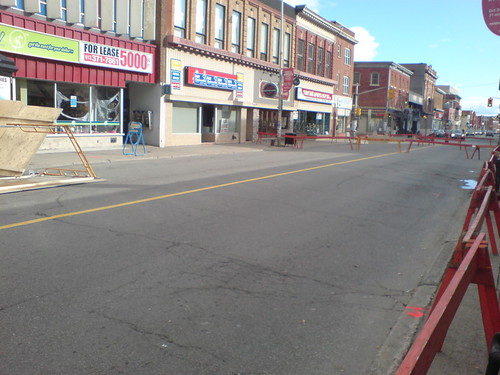
Photo available under CC-BY-NC-SA.
Two curious things about the bank street closure:
1) It was really weird to see people stick to the sidewalks, even when it was perfectly safe to walk on the road. Habit, I suppose.
2) Traffic didn’t seem that much more congested than usual, though I imagine that residents of nearby side-streets were not too pleased with buses running down their usually-quiet streets. This, combined with things going more-or-less fine during the multiple closures of Bank St. north of Laurier over the past year, makes me really wonder when people preach stories of doom and gloom should we ever think of building an above ground light-rail line why such fears are given the credence that they are.


 ]]>
]]>


 ]]>
]]> ]]>
]]>


 ]]>
]]>